Here is my website

Here is my music video

Sunday, 21 January 2018

3. What I have learnt about the codes and conventions of print adverts and how I intend to demonstrate this knowledge and understanding in my production in order to communicate meaning successfully

In the advertising industry, corporations use many different codes and conventions, in order to entice their audience, in order to persuade them persuade them to purchase the product/service they are selling.  In the TV advertising industry, codes and conventions can also be used to portray themes and messages in detail, further persuading people to purchase the product. Below, I have identified codes and conventions which I can incorporate into my own adverts, in order to persuade people to buy the deodorant I am promoting.

Each and every deodorant advert contains a pack shot at the end of it, in order to show the product to the audience, so they can get an idea of what it looks like, and recognise it when purchasing it. This pack shot also helps to promote the brand, as the product logo and name can also be seen in this shot.
Many deodorant adverts also feature use of the deodorant throughout its duration. This is so that the effect of the product can be linked to its brand identity, through the series of events throughout the advert, and so that the product can be persuaded in a positive light, thus persuading people to buy it.
Another common convention for deodorant adverts is to be set in an urban environment. This helps it to seem modern and trendy, and helps the target audience to relate to it. Each advert also has a basic storyline, usually on a modern topic that audiences can relate with. This storyline incoporates the deodorant into itself, to potray the deodorant positivly.

All cosmetics adverts use basic codes and conventions to suit themselves to their audience. It is therefore important that I do the same, as the themes mentioned in post 2 will not have a context without these technicalities, which work together with themes and ideas to appeal to a target audience in the fullest extent.

Tuesday, 16 January 2018

2. Existing averts/campaigns I have researched and how these have influenced my ideas

Research is essential when creating a new advertising campaign, as it helps to give an idea of what appeals to the campaign's target audience, through spotting conventions.  Without these codes and conventions, I would have much less of an idea on how to appeal to my target audience. I have used the three adverts below as the main inspiration for my ideas.

1- Nivea Men Stress Protect
Above is Nivea's Stress Protect deodorant advert for men. Although this a stereotypical advert that follows plenty of male conventions, like impressing the woman, it also explores unusual themes, like riding a motorcycle, and descending from a high platform, using a rope. This helps the advert to stand out from other countless deodorant adverts, and reflects the excitement the target audience may crave during their day-to-day lives. This allows it to appeal to them, as they can relate to the man in the advert, and wish they were more like him. I plan to include more exciting elements in my advert,  to appeal to my target audience in a similar manner, both male and female.

2- Lynx Peace Deodorant
This advert inspired potential advert ideas, through its youthful, liberalist type message that is often popular among 16-25 year olds. Instead of having one actor who is beautified and focused on, a wide range of characters and settings are introduced, representing different races and genders to an extent. I plan to subtly use these unconventional methods in my adverts.

3- Old Spice Terry Crews Adverts
Although the above clip is a mirage of several Terry Crews adverts, they all share the same codes and conventions, with the main one being random humour. These load, randomly occurring jokes hold a sense of comedic value for my target audience, and I therefore plan to use this element in my TV commercials. These adverts stand out from many other deodorant adverts across the internet, TV and social media, and as a result give Old Spice more of a presence in the cosmetics industry. 

Researching these adverts gave me an insight into popular themes and messages from my target audience group, and allowed me to brainstorm ideas incorporating these themes and messages into my TV adverts.  I will be incorporating comedic, lighthearted themes into my adverts, as well as liberalist messages.

Monday, 15 January 2018

1. How I intend to fulfil the requirements of the brief I have chosen

For this task, I have chosen the first brief, where I am required to create two 30 second adverts, for the new unisex deodorant, Wave. The adverts should be suitable for viewership on the channel E4, on weekdays, at 7-9 pm. The adverts must appeal to 16-25 year olds, both male and female, as the product is targeted at this age range.

I will use at least two actors; one per advert, of ages 16-17, and most liekely male and female. I will use these actors to represent the unisex target audience of 16-25. Also, I will consistantly express three key brand values, in order to well represent the target audience: active, youthful and unisex. I intend to follow the rules and regualtions set by the Advertising Standards Authority (ASA) when carrying this task out.

I intend to use conventional methods of deodorant adverts, like shot types, but I largely intend to break stereotypes as well. There is the possibility of challenging racial, gender and sexual stereotypes in my advert, carrying this out in a comedic sense, as I feel this is more likely to attract the attention of the target audience.

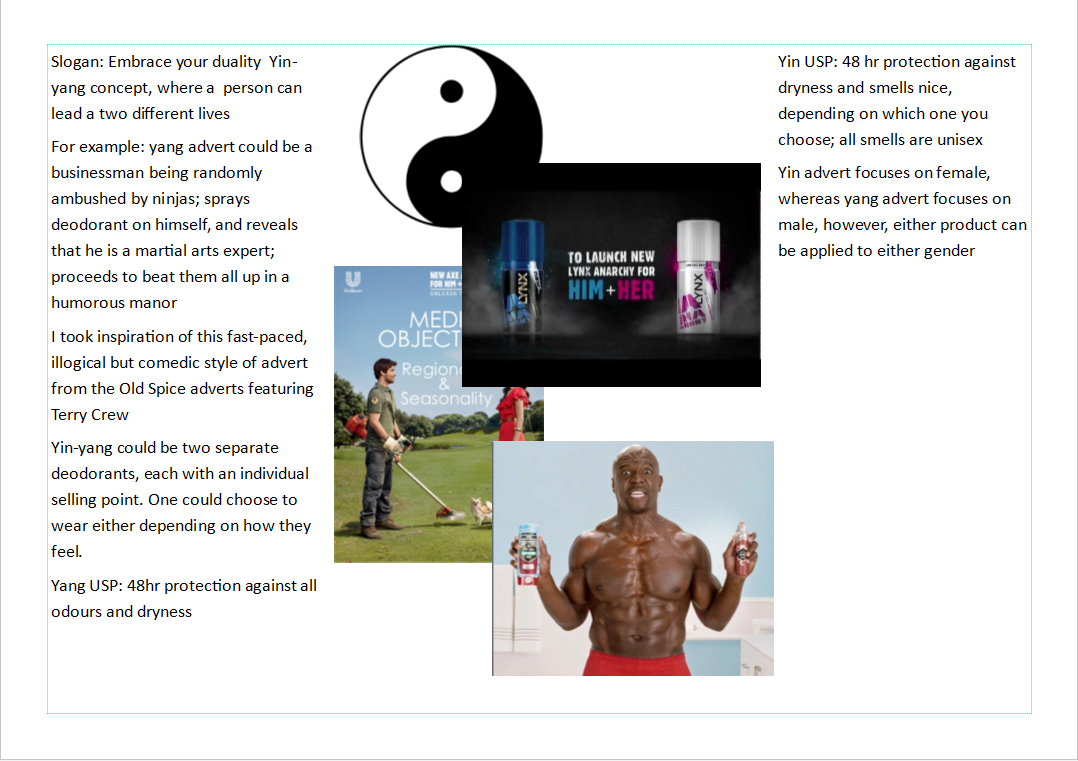
I will have two products, one presented in each advert, each with a different USP: one will offer 48 hr protection from odour and dryness, while the other protects from odours for 48 hr and smells really appealing. The products will both bear the same slogan, however: 'go against the flow', to show that people can be capable of completly new things if they put their mind to it. Each deodorant will be presented as a 'choice' (i.e. choose a certain deodorant depending on how you feel or, what you are going to do today). This will hopefully encourage consumers to purchase more than just one of the deodorants in the range.

During production, I intend to use two different settings: a park and a city. I will use only copyright free music and sounds, as well as creating my voice-over from scratch. There will be a variety of different camera shots and angles, such as long shot, mid shot, close up, low angle, pan and over the shoulder.

Below is my intial flat plan of ideas for my adverts:
Non-copyright music: This Is Me by Declan DP  https://www.youtube.com/watch?v=TKIR_JzPI7U
Ideas may be subject to change over the course; final ideas will be illustrated in post 10.

Monday, 8 January 2018

Homeland Continuity Task


1. What was your role in the task and what did you actually do?
I was an actor, playing the role of an Iranian ambassodor under interrogation. I had to learn my lines, and then play the role of the ambassodor in the shoot. I had to do this role somewhat convincingly, so the shoot ressembled a Homeland interrogation to an extent.


2. What factors did you have to take into account when planning, filming and editing?
We had to base our plotline around the brief, which stated that we required two people to enter a room, with one suspect sitting at a table. We had to try several practice takes, moving around tables, trying different lines of dialogue and incoperating different themes, in order to give our story a Homeland-esque feel. During filming, we tried different angles of shots, rehearsing the entire script at these different angles, in order to give people different types of shots to work with during editing. Finally, during editing, their were a number of things we had to take into consideration, in order to make the edit make sense. A large problem was the transtion between shots, and creating a linear flow; for example, opening and closing a door across two differents shots was difficult to edit, as the door couldn't look like it jumped from one position to another across shots.


3. How successful was your sequence? Did you manage to demonstrate match-on-action, shot-reverse-shot and the 180 degree rule? Did you achieve continuity overall?
I feel that we were, as a group, able to maintain the 180 degree rule, with a wide variety of shot types, allowing us to create a linear sequence, demonstrating both shot-reverse-shot and match-on-action, with different props and costumes taken into consideration, to create continuity within the sequence.


4. What have you learnt from completing this task?
I have learnt that the smallest details during planning affect filming for the better or worse, which in turn have massive effects on the edit. It is therefore important to pay close attention to detail throughout each stage, as these features could hinder/aid you later on.

Thursday, 21 December 2017

News Task

Explain your role/responsibility within the team and the task. What were you required to do?  
I was part of the team that took care of the website for our Daily Telegraph newspaper. I worked in a group of three, working together with Derek and Dara. Our task was to create a front page design and layout for our newspaper, using a template that was given to us. We had to find and resize different adverts for the page. The main task for this page was to create headlines for some select stories that we were given, ordering them on the page, and pairing them with the appropriate images, to capture the audience's attention. We also had to coordinate with the other groups, to make our different elements synegise, and make the newspaper feel realistic overall.


For one media form, describe the codes and conventions you chose to follow and explain their intended impact.
To make our webpage seem like it was produced by The Telegraph, we had to identify and apply the typical codes and conventions usually used by The Telegraph. For example, The Telegraph is a newspaper that writes its headlines in a non-bias way, only ever quoting the opinions of  those featured in their stories. Therefore, we only ever structured our headlines to grab our readers' attetention, and never to convey an opinion (eg 'Terror attack in Baghdad, 543 dead'- stat grabs audience attantion, whilst not conveying any stance in the issue) such as a paper like the Mirror would. We also included premium stories, as the Telegraph's website has a paywall, that restricts users from viewing certain stories without a digital subscription.

Explain how your choices reflect the real newspaper's values and target audience.
Our choices reflect the newspaper's values and their audience pretty well, in my opinion. For example, the Telegraph's readership enjoys stories about Brexit, as connoted from the prescence of several Brexit headlines and a Brexit tracker on the Telegraph website. So we used a Brexit story as our main story, as to well represent the Telegraph newspaper, and grab the audience's attention. We also noticed that demographics for the Telegraph readership saw most reader to be middle/upper middle class, so we included high class adverts, such as the Tiffany's jewellery ad at the top of the page.

Explain how your team adapted the news across the three different media forms and the reasons behind your decisions.
Our team used three different forms of media: print, digital and social media. We had to communicate between each other to keep things like headlines and featured stories consistant (the print couldn't have a different main story to the digital for example), whilst also changing things around (the images used for each story would be different across all three platforms, as not to be repetitive).

In hindsight, is there anything about your team's outcomes that you would adapt or improve?
I think that our team could have adapted the fonts to represent the Telegraph more, and I think collabiration between groups could have been better, as our team put in the wrong headlines at times. Overall though, I think the team did a good job adapting to represent the Telegraph, and that the end product would seem pretty realistic if it was ever produced.

Wednesday, 6 December 2017

Minecraft Youtube Video

1. How you did it- What videos did you look at, what technology did you use and how?
I looked at some of the content produced by Minecraft youtubers such as DanTDM, in order to get a feel for how a traditional Minecraft videos are produced, and how they attract their large audiences online. The videos online all showed a few similarities; have a loud, bubbly personality, keep your jokes kid friendly, and scream into the microphone as loud as you can. However, I felt some of these trends weren't necessary to produce a Minecraft video, so I left them out.

Producing the video involved using already exsisting footage from a youtuber online, and overlapping it with a facial recording, which was recorded on an iPad. Filmmaker Pro was then used to combine the footage into the video.


2.How your video might attract the attention of Mojang and/or Microsoft, and how it might influence them.
If my video attracted the attention of the community, the channel would gain a following, and attract Mojang/Microsoft's attention. As a result, I would become a prosumer, and be asked to test and review new and exclusive content for the community, and deem it suitable to play, like many prosumers do in the gaming industry.

Tuesday, 5 December 2017

Billboard Magazine Cover


1.   Summarise the music celebrity you have created.  Include name, music genre, personality and how they are being used to comment on contemporary celebrity. The celebrity I have created is called Rahul Jaipindi. He is an Indian jazz artist that enjoys combining other music forms with jazz. He has received media attention for breaking stereotypical boundairies and promoting old forms of music like jazz.

2.   Evaluate how you have constructed the representation of your celebrity through your cover image and cover headline/text (denotation/connotation of text and image). Rahul is a modest man, and does not wear flashy clothes or accessories. He does follow the stereotypical jazz outlook though, waering a black suit and tie, as well as a fedora. The white text helps contrast with his choice of clothing, and brings back the jazz era vibe through use of black and white only.

3.   Analyse how far you have used and/or challenged stereotypes of gender/race/age/sexuality in your cover. I have challenge a racial stereotype on my cover, as it is not usual to associate Asian people with jazz. The name 'Rahul Jaipindi' is blatant and large, to spell out to the audience in bold letters that my celebrity is not one to attune to stereotypes.

4.   Reflect on the production/editing process.  Are you pleased with the end result?
Identify what is successful about your shot?  What would you have done differently in hindsight? The model shot is a medium long shot, and I like the way it blends in nicely with the background, and contrasts well with the text. The model's pose also fits in, as it is not to flashy or showing-off, keeping the audience's eyes on the celebrity's face, and helping them to notice the fact that my celebrity is challenging racil stereotypes. I feel that the cover looks bare. however, and the text alignment could be better, as to put audience focus on the text as well.